ASTRONOMY AND COSMOLOGY IN STAMPS (from University of
Buffalo Libraries, http://ublib.buffalo.edu/libraries/units/sel/exhibits/stamps/cosmo1.htm)
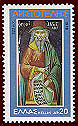 A reference to Aristotle is essential in a history of science, though impossible in a few
sentences without being banal. This greatest of all Greek philosophers, who flourished in
the 4th century BC, exerted an all-encompassing influence on the development of western
thought. He introduced the systematic study of logic which he applied to his teachings. In
his biological writings he presented a classification system of animals that was not fully
replaced until the time of Linnaeus. All branches of knowledge were classified: physics,
methaphysics, rhetoric, poetics. His picture of a perfect, unchanging, spherical universe
centered on the earth placed a long-lasting damper on western understanding of the
workings of the physical world, particularly the motions of the stars and planets. To the
four supposed elements making up the universe, earth, water, air, and fire, he added a
fifth, invisible element, the ether. This ether, made necessary because "nature
abhorrs a vacuum", was an inpalpable fixture for over 2000 years until its existence
was disproved by the Michelson-Morley experiment. His teachings, lost to western Europe
during the dark ages, were reintroduced after contacts with the Arab world increased. The
Scholastics reconciled Christian dogma with Aristotle's ideas, which virtually became
dogma in secular learning. This discouraged independent scientific observation, inquiry,
and experiment, even though Aristotle himself had been an interested observer of the
natural world.
A reference to Aristotle is essential in a history of science, though impossible in a few
sentences without being banal. This greatest of all Greek philosophers, who flourished in
the 4th century BC, exerted an all-encompassing influence on the development of western
thought. He introduced the systematic study of logic which he applied to his teachings. In
his biological writings he presented a classification system of animals that was not fully
replaced until the time of Linnaeus. All branches of knowledge were classified: physics,
methaphysics, rhetoric, poetics. His picture of a perfect, unchanging, spherical universe
centered on the earth placed a long-lasting damper on western understanding of the
workings of the physical world, particularly the motions of the stars and planets. To the
four supposed elements making up the universe, earth, water, air, and fire, he added a
fifth, invisible element, the ether. This ether, made necessary because "nature
abhorrs a vacuum", was an inpalpable fixture for over 2000 years until its existence
was disproved by the Michelson-Morley experiment. His teachings, lost to western Europe
during the dark ages, were reintroduced after contacts with the Arab world increased. The
Scholastics reconciled Christian dogma with Aristotle's ideas, which virtually became
dogma in secular learning. This discouraged independent scientific observation, inquiry,
and experiment, even though Aristotle himself had been an interested observer of the
natural world.
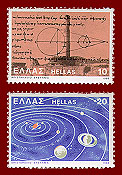 Aristarchus of Samos (3rd century BC) considered the sizes and
distances of the sun and the moon, and was the first to try to calculate the distances of
these bodies geometrically . Furthermore, he advanced the theory that the sun was at rest
at the center of the sphere of fixed stars, and that the earth and planets revolved around
the sun. The apparent motion of the stars was due to the daily rotation of the earth.
Copernicus was familiar with Aristarchus' theory of the universe, which at the time,
however, did not find favor with the ancient philosophers.
Aristarchus of Samos (3rd century BC) considered the sizes and
distances of the sun and the moon, and was the first to try to calculate the distances of
these bodies geometrically . Furthermore, he advanced the theory that the sun was at rest
at the center of the sphere of fixed stars, and that the earth and planets revolved around
the sun. The apparent motion of the stars was due to the daily rotation of the earth.
Copernicus was familiar with Aristarchus' theory of the universe, which at the time,
however, did not find favor with the ancient philosophers.
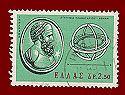 Hipparchus (2nd century BC), the greatest astronomer of the ancient world,
is thought to have invented the astrolabe. He continued the work of Aristarchus in
calculating the distance of the moon by measuring its parallax against the sphere of fixed
stars. His result of 30 earth diameters is correct. From his observations he produced the
first star catalogue, grading the stars by brightness. He also discovered the precession
Hipparchus (2nd century BC), the greatest astronomer of the ancient world,
is thought to have invented the astrolabe. He continued the work of Aristarchus in
calculating the distance of the moon by measuring its parallax against the sphere of fixed
stars. His result of 30 earth diameters is correct. From his observations he produced the
first star catalogue, grading the stars by brightness. He also discovered the precession
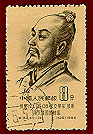 Zhang Heng (78-139) was a Chinese astronomer, geographer, and mathematician.
He constructed a celestial globe, believing that the world was round, "The sky is
like a hen's egg, and is as round as a crossbow pellet; the Earth is like the yolk of the
egg, lying alone at the centre. The sky is large and the Earth small." He also
created a primitive, but very fanciful seismograph. His approximation of pi was the square
root of 10.
Zhang Heng (78-139) was a Chinese astronomer, geographer, and mathematician.
He constructed a celestial globe, believing that the world was round, "The sky is
like a hen's egg, and is as round as a crossbow pellet; the Earth is like the yolk of the
egg, lying alone at the centre. The sky is large and the Earth small." He also
created a primitive, but very fanciful seismograph. His approximation of pi was the square
root of 10.
 Ptolemy
(2nd century AD) was a famous astronomer, mathematician and geographer whose geocentric
view of the universe was dogma in western thought until 1200 years later, when Copernicus
was able to offer a competing heliocentric model which accounted just as well for many of
its inconsistencies with observations. Ptolemy synthesized and extended the star catalogue
of Hipparchus and much of Greek astronomy in his Almagest.
Ptolemy
(2nd century AD) was a famous astronomer, mathematician and geographer whose geocentric
view of the universe was dogma in western thought until 1200 years later, when Copernicus
was able to offer a competing heliocentric model which accounted just as well for many of
its inconsistencies with observations. Ptolemy synthesized and extended the star catalogue
of Hipparchus and much of Greek astronomy in his Almagest.
<
 A
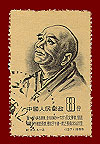
Chinese astronomer and Buddhist monk of the Tang dynasty, Zhang Sui (683-727), was the
first to describe proper stellar motion, or the apparent motion of stars across the plane
of the sky relative to more distant stars. In Western astronomy, Edmond Halley is credited
with this discovery in 1718 for some stars from Ptolemy's catalogue.
A
Chinese astronomer and Buddhist monk of the Tang dynasty, Zhang Sui (683-727), was the
first to describe proper stellar motion, or the apparent motion of stars across the plane
of the sky relative to more distant stars. In Western astronomy, Edmond Halley is credited
with this discovery in 1718 for some stars from Ptolemy's catalogue.
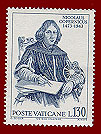
 Nicolaus Copernicus (1473-1543), a Polish astronomer, proposed a
heliocentric theory of the universe in which the planets orbited the sun, rather than the
earth. It marked the end of the world with man and the earth at its center. Ironically,
Copernicus appears here on a Vatican stamp for a theory that flew in the face of
established religion in his time. Although known portraits of Copernicus are full face,
one modern artist's conception (below, left) shows a thoughtful man in profile. The French
stamp (below) shows a picture of the universe as Copernicus envisioned it -- the six known
planets circling the sun. Silhouettes of the Polish churches from whose towers Copernicus
made his observations are in the foreground. The souvenir sheet on the right shows the
Copernican world view from a beautiful celestial atlas made by Andreas Cellarius, Harmonia
Macrocosmica, 1661,
Nicolaus Copernicus (1473-1543), a Polish astronomer, proposed a
heliocentric theory of the universe in which the planets orbited the sun, rather than the
earth. It marked the end of the world with man and the earth at its center. Ironically,
Copernicus appears here on a Vatican stamp for a theory that flew in the face of
established religion in his time. Although known portraits of Copernicus are full face,
one modern artist's conception (below, left) shows a thoughtful man in profile. The French
stamp (below) shows a picture of the universe as Copernicus envisioned it -- the six known
planets circling the sun. Silhouettes of the Polish churches from whose towers Copernicus
made his observations are in the foreground. The souvenir sheet on the right shows the
Copernican world view from a beautiful celestial atlas made by Andreas Cellarius, Harmonia
Macrocosmica, 1661,  This planisphere shows the solar system updated from Copernicus' time; the
four moons of Jupiter are clearly visible. Venus appears to be obscured by the vertical
stamp perforations; on other editions of this work the planets are shown in somewhat
shifted positions. This universe is flanked by two figures: at right Copernicus himself,
and at left Aristarchus of Samos, the earlier proponent of the heliocentric theory, here
lending weight to Copernicus' theory.
This planisphere shows the solar system updated from Copernicus' time; the
four moons of Jupiter are clearly visible. Venus appears to be obscured by the vertical
stamp perforations; on other editions of this work the planets are shown in somewhat
shifted positions. This universe is flanked by two figures: at right Copernicus himself,
and at left Aristarchus of Samos, the earlier proponent of the heliocentric theory, here
lending weight to Copernicus' theory.


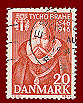
 Tycho Brahe (1546-1601) was the last and greatest of the
naked-eye astronomers, rivalled only perhaps by Hipparchus. His book on his observations
of an exploding star, De Nova Stella, gives us the word "nova." His many
painstaking observations were passed on to his assistant Kepler, who used them to derive
his three laws of planetary motion in a heliocentric universe, while Tycho himself had
remained an adherent of the Ptolemaic geocentric world view. For over 20 years Tycho made
observations from his castle Uraniborg on the island of Ven, given him as a fief by the
king to keep the famed astronomer in Denmark. The layout of the castle was geometric and
perfectly aligned with the compass. His instruments, built to his own specifications and
design, were large scale to provide greater accuracy than achieved before. The stamps on
the right were a joint
Tycho Brahe (1546-1601) was the last and greatest of the
naked-eye astronomers, rivalled only perhaps by Hipparchus. His book on his observations
of an exploding star, De Nova Stella, gives us the word "nova." His many
painstaking observations were passed on to his assistant Kepler, who used them to derive
his three laws of planetary motion in a heliocentric universe, while Tycho himself had
remained an adherent of the Ptolemaic geocentric world view. For over 20 years Tycho made
observations from his castle Uraniborg on the island of Ven, given him as a fief by the
king to keep the famed astronomer in Denmark. The layout of the castle was geometric and
perfectly aligned with the compass. His instruments, built to his own specifications and
design, were large scale to provide greater accuracy than achieved before. The stamps on
the right were a joint  issue of Denmark and Sweden. One shows a plan of
Uraniborg and its grounds, the other, one of Tycho's instruments. On the stamp appears the
longest word I have ever seen on a stamp: ekvatotialarmillarinstrument. Identified as a
sextant in Scott, it is almost certainly the great equatorial armillary sphere (1585) . It
consisted of one single declination circle, 272 cm in diameter, and a semicircle
representing the equator, 350 cm in diameter. Full descriptions of all his instruments and
the castle can be found on the Official Tycho Brahe Website .
issue of Denmark and Sweden. One shows a plan of
Uraniborg and its grounds, the other, one of Tycho's instruments. On the stamp appears the
longest word I have ever seen on a stamp: ekvatotialarmillarinstrument. Identified as a
sextant in Scott, it is almost certainly the great equatorial armillary sphere (1585) . It
consisted of one single declination circle, 272 cm in diameter, and a semicircle
representing the equator, 350 cm in diameter. Full descriptions of all his instruments and
the castle can be found on the Official Tycho Brahe Website . 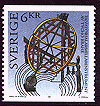
 Johannes
Kepler (1571-1630) was a German mathematician who is remembered for his three laws of
planetary motion, derived empirically from Tycho Brahe's data and observations, which
describe the solar system having the sun at the focus of elliptic planetary orbits. In his
writings on conic sections he introduced the word "focus" into mathematical
language.
Johannes
Kepler (1571-1630) was a German mathematician who is remembered for his three laws of
planetary motion, derived empirically from Tycho Brahe's data and observations, which
describe the solar system having the sun at the focus of elliptic planetary orbits. In his
writings on conic sections he introduced the word "focus" into mathematical
language.
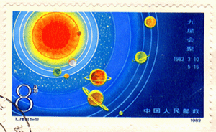 This colorful Chinese stamp approximates our current view of the
solar system, even showing the asteroid belt between the orbits of Mars and Jupiter. It
was issued in 1982 to mark a rare alignment of the planets twice during that year, in in
March and May. The nine planets clustered into a relatively small fan-shaped area on the
same side of the sun, in arcs of 96 and 105 degrees. The average cycle for such an event
is 179 years, and the next one is estimated to happen in 2357. This clustering, or
conjunction, is also called syzygy, a word worth remembering for a game of Scrabble.
This colorful Chinese stamp approximates our current view of the
solar system, even showing the asteroid belt between the orbits of Mars and Jupiter. It
was issued in 1982 to mark a rare alignment of the planets twice during that year, in in
March and May. The nine planets clustered into a relatively small fan-shaped area on the
same side of the sun, in arcs of 96 and 105 degrees. The average cycle for such an event
is 179 years, and the next one is estimated to happen in 2357. This clustering, or
conjunction, is also called syzygy, a word worth remembering for a game of Scrabble.
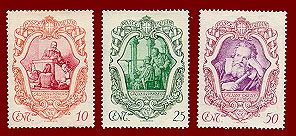

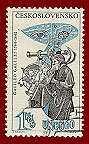 Galileo
Galilei (1564-1642), first to devise and use a telescope for astronomical observations,
discovered the moons of Jupiter, and the motion of sunspots across the solar disc - sign
of a less than perfect sun, which also rotated! His many observations confirmed the
Copernican theory of the motion of earth and planets around the sun, and brought him in
conflict with the Inquisition; for such heresy he spent his last years under house arrest.
Here he is honored on Italian and Czech stamps: eppur si muove!
Galileo
Galilei (1564-1642), first to devise and use a telescope for astronomical observations,
discovered the moons of Jupiter, and the motion of sunspots across the solar disc - sign
of a less than perfect sun, which also rotated! His many observations confirmed the
Copernican theory of the motion of earth and planets around the sun, and brought him in
conflict with the Inquisition; for such heresy he spent his last years under house arrest.
Here he is honored on Italian and Czech stamps: eppur si muove!
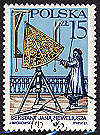
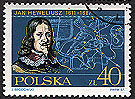 Johann Hevelius (1611-87) was a wealthy brewer in
Danzig who dedicated his life and fortune to the study of astronomy. He built enormously
long telescopes and other outsize apparatus on the roof of his house (Newton's reflecting
telescope had not yet been invented). He mapped and named craters and mountains on the
moon and in 1647 published Selenographia, the first illustrated work of astronomy dealing
exclusively with the moon. He also published a stellar atlas, Firmamentum Sobiescianum,
observed and mapped nebulosities including the Andromeda nebula, and recorded several
decades of sunspot observations. These Polish stamps show Hevelius from a portrait in
Selenographia superimposed on a chart of constellations, and also with his six foot radius
brass sextant on the roof of his house. His celestial atlas Uranographia of 1690 may be
viewed on the website of the Brera Astronomical Observatory.
Johann Hevelius (1611-87) was a wealthy brewer in
Danzig who dedicated his life and fortune to the study of astronomy. He built enormously
long telescopes and other outsize apparatus on the roof of his house (Newton's reflecting
telescope had not yet been invented). He mapped and named craters and mountains on the
moon and in 1647 published Selenographia, the first illustrated work of astronomy dealing
exclusively with the moon. He also published a stellar atlas, Firmamentum Sobiescianum,
observed and mapped nebulosities including the Andromeda nebula, and recorded several
decades of sunspot observations. These Polish stamps show Hevelius from a portrait in
Selenographia superimposed on a chart of constellations, and also with his six foot radius
brass sextant on the roof of his house. His celestial atlas Uranographia of 1690 may be
viewed on the website of the Brera Astronomical Observatory.
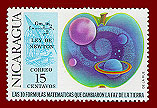
Newton's law of universal gravitation applies not only to apples falling from trees, but
also describes the relationship of mutual attraction between planets and celestial bodies
in the universe.

 The return of Halley's comet in 1986 was an event that captured
the imagination and also occasioned an outpouring of philatelic materials around the
world. The British possession St Helena was the first to weigh in with a set that
commemorates astronomer Edmund Halley's (1656-1742) visit in 1677 to that remote
The return of Halley's comet in 1986 was an event that captured
the imagination and also occasioned an outpouring of philatelic materials around the
world. The British possession St Helena was the first to weigh in with a set that
commemorates astronomer Edmund Halley's (1656-1742) visit in 1677 to that remote 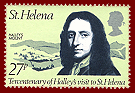 island
in the South Atlantic to prepare the first stellar atlas of the southern hemisphere. Most
spectacular in this set is the contemporary reproduction of the comets image from that
comic strip of the Norman Conquest of England in 1066, the Bayeux Tapestry, while Halley's
sextant on the stamp below could pass for a quadrant. But only a few years after this
visit, Halley speculated that the comet of 1682 had actually been observed before at
regular intervals. He calculated the orbit of this comet now named for him, and correctly
predicted its return in 1758, in a first application of Newton's laws of motion. The comet
has returned twice this century, in 1910 and 1986, or "twice in a
lifetime" for a lucky few. The Australian stamp at the right
island
in the South Atlantic to prepare the first stellar atlas of the southern hemisphere. Most
spectacular in this set is the contemporary reproduction of the comets image from that
comic strip of the Norman Conquest of England in 1066, the Bayeux Tapestry, while Halley's
sextant on the stamp below could pass for a quadrant. But only a few years after this
visit, Halley speculated that the comet of 1682 had actually been observed before at
regular intervals. He calculated the orbit of this comet now named for him, and correctly
predicted its return in 1758, in a first application of Newton's laws of motion. The comet
has returned twice this century, in 1910 and 1986, or "twice in a
lifetime" for a lucky few. The Australian stamp at the right shows a plot of the earth's and the comet's trajectories around the sun over
the image of
shows a plot of the earth's and the comet's trajectories around the sun over
the image of 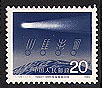 a large radiotelescope.
 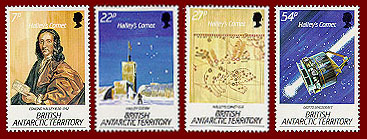 Britain was also among the nations to mark the
comet's return with commemorative stamps and investigated it via the space probe Giotto.
Notice how Orion appears "upside down" to observers in Antarctica for British
Antarctic Territories. The PRC stamp at left shows the comet streaking from right to left
over the curved earth and over some mysterious symbols, whose meaning is explained below
in notes to the Stamp Index.
Britain was also among the nations to mark the
comet's return with commemorative stamps and investigated it via the space probe Giotto.
Notice how Orion appears "upside down" to observers in Antarctica for British
Antarctic Territories. The PRC stamp at left shows the comet streaking from right to left
over the curved earth and over some mysterious symbols, whose meaning is explained below
in notes to the Stamp Index.
The Jesuit Pietro Secchi (1818-1878), an Italian astronomer, was the  first to apply spectroscopy and photography to astronomy, taking spectra of
the stars and photographs of the sun during eclipses. His compilation of stellar spectra
led to the classification of the well-known spectral types of stars. As longtime director
of the Gregorian University Observatory in Rome, he introduced the newest equipment for
his studies.
first to apply spectroscopy and photography to astronomy, taking spectra of
the stars and photographs of the sun during eclipses. His compilation of stellar spectra
led to the classification of the well-known spectral types of stars. As longtime director
of the Gregorian University Observatory in Rome, he introduced the newest equipment for
his studies.
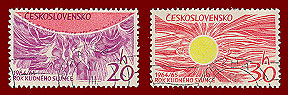
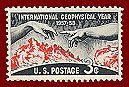 The International Geophysical Year 1957 is noted on the U.S.
stamp below with solar flares and a nod to Michelangelo's creation of man from the Sistine
Chapel. Solar flares are best observed during a total solar eclipse, as is the corona
(center). The corona extends thousands of miles, 30 solar radii, beyond the surface of the
sun and changes in shape with sun spot activity. It is highly ionized and reaches
temperatures of more than one million degrees K.
The International Geophysical Year 1957 is noted on the U.S.
stamp below with solar flares and a nod to Michelangelo's creation of man from the Sistine
Chapel. Solar flares are best observed during a total solar eclipse, as is the corona
(center). The corona extends thousands of miles, 30 solar radii, beyond the surface of the
sun and changes in shape with sun spot activity. It is highly ionized and reaches
temperatures of more than one million degrees K.

 A solar eclipse takes place when the new moon passing between the
sun and the earth blocks the solar radiation and casts its shadow on the
A solar eclipse takes place when the new moon passing between the
sun and the earth blocks the solar radiation and casts its shadow on the 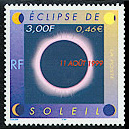 earth.
It can be total, partial, or annular. Total eclipses here commemorated were observed in
Mexico in 1970, and the Philippines in 1995. The solar eclipse of August 1999 cut a swath
from the extreme eastern shore of Canada across the Atlantic Ocean, then Great Britain and
Central Europe, and was thus viewed by millions of enthusiastic observers. Postal entities
followed the cue and issued many stamps and special cancellations. Shown here is a French
stamp of totality, with a splendid corona framing the eclipsed solar disk. The progression
of the phenomenon is shown counterclockwise from the upper right corner of the stamp. The
new monetary unit of the European Union, the Euro, has also crept into the upper right
corner. An earlier eclipse stamp from Mexico in 1942 honors the inauguration of the
astrophysical observatory in
earth.
It can be total, partial, or annular. Total eclipses here commemorated were observed in
Mexico in 1970, and the Philippines in 1995. The solar eclipse of August 1999 cut a swath
from the extreme eastern shore of Canada across the Atlantic Ocean, then Great Britain and
Central Europe, and was thus viewed by millions of enthusiastic observers. Postal entities
followed the cue and issued many stamps and special cancellations. Shown here is a French
stamp of totality, with a splendid corona framing the eclipsed solar disk. The progression
of the phenomenon is shown counterclockwise from the upper right corner of the stamp. The
new monetary unit of the European Union, the Euro, has also crept into the upper right
corner. An earlier eclipse stamp from Mexico in 1942 honors the inauguration of the
astrophysical observatory in 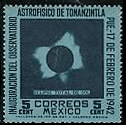
 Tonanzintla
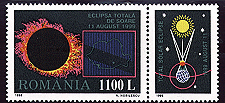
that year. Among the more interesting stamps featuring the eclipse of August 1999 is from
Romania. It has a tag with a diagram, not drawn to scale, showing the alignment of sun,
moon, and earth necessary to produce an eclipse. The stamp itself shows the corona of an
eclipsed sun, and in a rectangle a map of Romania with the projected swath of the eclipse
across it. The legend "total solar eclipse" and the date appear in English on
the tag and in Romanian on the stamp itself, while the date of issue is 1998 - earlier
than the event perhaps in anticipation of philatelic demand. The USPS in 2000 issued a
minisheet called Exploring the
Tonanzintla
that year. Among the more interesting stamps featuring the eclipse of August 1999 is from
Romania. It has a tag with a diagram, not drawn to scale, showing the alignment of sun,
moon, and earth necessary to produce an eclipse. The stamp itself shows the corona of an
eclipsed sun, and in a rectangle a map of Romania with the projected swath of the eclipse
across it. The legend "total solar eclipse" and the date appear in English on
the tag and in Romanian on the stamp itself, while the date of issue is 1998 - earlier
than the event perhaps in anticipation of philatelic demand. The USPS in 2000 issued a
minisheet called Exploring the 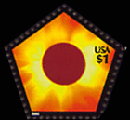 Solar System of five $1.- pentagonal stamps showing
various aspects of the sun, including the eclipse below, right.
Solar System of five $1.- pentagonal stamps showing
various aspects of the sun, including the eclipse below, right.
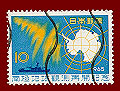
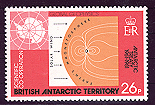 The auroras near the north and south magnetic poles, bright pulsating bands
in the night sky at altitudes ranging from 70 to 300 km, are due to particles originating
from the sun, which then collide with atmospheric atoms, causing them to emit light. The
Aurora Australis and Antarctica are shown on a 1965 stamp, commemorating a Japanese
scientific expedition. The distortion of the earth's magnetic field, or magnetosphere, by
the so-called solar wind is shown in a stamp from the British Antarctic Territory on the
left.
The auroras near the north and south magnetic poles, bright pulsating bands
in the night sky at altitudes ranging from 70 to 300 km, are due to particles originating
from the sun, which then collide with atmospheric atoms, causing them to emit light. The
Aurora Australis and Antarctica are shown on a 1965 stamp, commemorating a Japanese
scientific expedition. The distortion of the earth's magnetic field, or magnetosphere, by
the so-called solar wind is shown in a stamp from the British Antarctic Territory on the
left.
The Aurora Borealis appears on a Soviet stamp honoring the International Geophysical Year
1957-1958. Last but not least, the small stamp from Greenland packs a mighty punch,
showing a northern lights display between the Big Dipper and Polaris.
 The Hertzsprung-Russell diagram shown on the Mexican stamp at left is a
graphic relation of the absolute magnitude of stars to their spectral class or
temperature. Such classification aims at grouping like stars together in a meaningful way
so that each star does not have to be described anew individually. Attempts at
classification were already made by Secchi, who grouped stellar spectra into four classes,
depending on the absorption lines seen, and were continued by the Danish astronomer Ejnar
Hertzsprung (1873-1967) and independently by the American astronomer Henry Norris Russell
(1877-1957) after whom the resulting composite graph is named. The main sequence of stars
runs from the upper left corner where the hottest, brightest stars are placed (blue
giants) to the lower right, where the smallest, dimmest stars reside (red dwarfs). Our
sun, a yellow star, falls about into the middle of this sequence, which can also be viewed
in time as the evolution of a star from its hot, bright, early stages to cooler, dim, late
stages. In the upper right corner are very bright giants or supergiants who are however
rather cool, as evidenced by their red color (Betelgeuse).
The Hertzsprung-Russell diagram shown on the Mexican stamp at left is a
graphic relation of the absolute magnitude of stars to their spectral class or
temperature. Such classification aims at grouping like stars together in a meaningful way
so that each star does not have to be described anew individually. Attempts at
classification were already made by Secchi, who grouped stellar spectra into four classes,
depending on the absorption lines seen, and were continued by the Danish astronomer Ejnar
Hertzsprung (1873-1967) and independently by the American astronomer Henry Norris Russell
(1877-1957) after whom the resulting composite graph is named. The main sequence of stars
runs from the upper left corner where the hottest, brightest stars are placed (blue
giants) to the lower right, where the smallest, dimmest stars reside (red dwarfs). Our
sun, a yellow star, falls about into the middle of this sequence, which can also be viewed
in time as the evolution of a star from its hot, bright, early stages to cooler, dim, late
stages. In the upper right corner are very bright giants or supergiants who are however
rather cool, as evidenced by their red color (Betelgeuse).
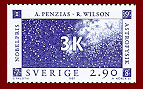 Hello! It is cold outside, 3 degrees! Three degrees Kelvin, that is, in
intergalactic space. This surprising discovery was made by researchers Arno Penzias
(1933-) and Robert Wilson (1936-) at Bell Labs in New Jersey, with a receiver originally
built for satellite communication. They found that cosmic microwave radiation of uniform
strength was received from all directions, and it was supposed that this radiation was the
remains of the Big Bang. The shape of the spectrum is indeed like that of a black body
with a temperature of 3 degrees Kelvin, supporting the Big Bang theory of creation rather
than the steady state hypothesis. Penzias and Wilson shared one half of the 1978 Nobel
physics prize for this discovery; the other half went to Piotr Leontevitch Kapitsa
(1894-1984), for his discoveries in the area of low temperature physics. A Swedish stamp
has not yet been issued in his honor.
Hello! It is cold outside, 3 degrees! Three degrees Kelvin, that is, in
intergalactic space. This surprising discovery was made by researchers Arno Penzias
(1933-) and Robert Wilson (1936-) at Bell Labs in New Jersey, with a receiver originally
built for satellite communication. They found that cosmic microwave radiation of uniform
strength was received from all directions, and it was supposed that this radiation was the
remains of the Big Bang. The shape of the spectrum is indeed like that of a black body
with a temperature of 3 degrees Kelvin, supporting the Big Bang theory of creation rather
than the steady state hypothesis. Penzias and Wilson shared one half of the 1978 Nobel
physics prize for this discovery; the other half went to Piotr Leontevitch Kapitsa
(1894-1984), for his discoveries in the area of low temperature physics. A Swedish stamp
has not yet been issued in his honor.
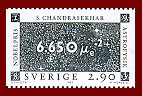 Subramanian Chandrasekhar (1910-1995) shared the 1983 Nobel prize
for physics for his theoretical studies of the physical processes relating to the
structure and evolution of the stars, particularly white dwarfs, stars at the evolutionary
end of stellar development. Chandrasekhar calculated that white dwarfs cannot have a mass
greater than 1.4 solar masses without collapsing into an even denser state, a neutron
star. The expression for this critical mass is shown on the stamp at left.
Subramanian Chandrasekhar (1910-1995) shared the 1983 Nobel prize
for physics for his theoretical studies of the physical processes relating to the
structure and evolution of the stars, particularly white dwarfs, stars at the evolutionary
end of stellar development. Chandrasekhar calculated that white dwarfs cannot have a mass
greater than 1.4 solar masses without collapsing into an even denser state, a neutron
star. The expression for this critical mass is shown on the stamp at left.
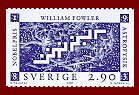 William A Fowler (1911-1995) shared the 1993 Nobel physics prize with
Chandrasekhar for important astrophysical discoveries in his theoretical and experimental
studies of nuclear reactions in the formation of the chemical elements in the universe,
from the mostly hydrogen and helium created in the Big Bang.The chart of nuclides on the
stamp shows stable heavy nuclei between hafnium and lead.
William A Fowler (1911-1995) shared the 1993 Nobel physics prize with
Chandrasekhar for important astrophysical discoveries in his theoretical and experimental
studies of nuclear reactions in the formation of the chemical elements in the universe,
from the mostly hydrogen and helium created in the Big Bang.The chart of nuclides on the
stamp shows stable heavy nuclei between hafnium and lead.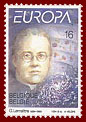
Georges Edouard Lemaitre (1894-1966), a Belgian cosmologist, astrophysicist and priest,
was interested in the problem of the creation of the universe and proposed a theory of an
expanding universe based on his solutions to Einsteins equations of general relativity. He
envisioned a primal atom containing all the matter in the universe, which exploded at some
point 10-20 billion years ago, hurtling elementary particles and photons outward, where
they cooled and condensed eventually to form the light elements, heavy elements,
molecules, and finally galaxies. The Big Bang theory, as it was derisively called by Fred
Hoyle, a proponent of a steady state theory of the universe, is supported by many
independent astronomical observations, starting with Hubble's observations of receding
galaxies and the discoveries of Penzias, Wilson, and Fowler, above. 
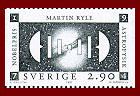
Radioastronomer Antony Hewish (1924- ) and his graduate student Jocelyn Bell discovered
radio sources in space that were called pulsars, because of their regular emission of
pulsed energy. This confirmed the existence of neutron stars, extremely dense collapsed
stars at the center of the pulsars which are highly magnetized. He shared the 1974 Nobel
prize in physics with Martin Ryle (1918-1984), who was recognized for his achievements in
radiotelescope construction. Known as the aperture synthesis technique, this method
employs several small telescopes deployed over a distance of about three miles whose
positions are mutually adjustable and who act as one enormous composite telescope of
corresponding size. The Ryle stamp shows two symbolic radiotelescopes receiving radiation
from a radiogalaxy. The Hewish stamp shows a stylized pulse signal superimposed on the
Crab Nebula, a supernova remnant which was first observed by Chinese astronomers in the
11th century, and which has a pulsar emitting energy bursts across the whole spectrum at
its center. The five stamps of this stunning 1987 Swedish set vary in color from a deep
blue to black, like the night sky.
Long before the invention of the telescope, people of ancient civilizations observed,
cataloged and named visible, bright objects in the sky: planets, stars, comets, and
constellations -- groups of stars seemingly always occurring together in the same spatial
configuration, and recurring year after year with the seasons. Along the ecliptic, the
plane of the earth's orbit around the sun (or the apparent motion of the sun among the
stars for an observer on earth), twelve constellations are observed which give the names
assigned to them in antiquity to the signs of the Zodiac, probably by the Mesopotamians
two millennia BC. By "fleshing out" the shape of a bear, bull, or ram around the
major stars in a constellation, ancient observers populated the heavens with creatures and
objects more meaningful to the mortal imagination than these actual random groupings of
stars many lightyears apart . The recognition of constellations as such by an observer
makes it easier to locate other celestial objects like planets, comets, or distant
galaxies within the constellation's area against the sphere of fixed stars.
Swedish Post issued this interesting booklet of stamps showing constellations of the
zodiac inside images of their mythological bodies. Issued without denomination, each
triangular stamp covers the minimum domestic letter rate. Constellations that appear on
other stamps on these pages are the following: Omega, Orion, Leo, Cygnus, Ursa Major, Ursa
Minor, and the Pleiades.
In the northern hemisphere voyages of exploration and trade were undertaken initially
without the aid of compass or maps. Ancient mariners sailed usually within sight of land,
which was possible around the Mediterranean, and in the Baltic Sea. Added directional help
came from the Pole Star, Polaris, so called because it is near the north celestial pole.
The elevation of this star over the horizon provided a measure of latitude; the higher
Polaris, the more northerly the location. Polaris is also known as the Lodestar, as
associated with a lodestone. This naturally occurring magnetic material could be used to
make a primitive compass by magnetizing iron needles, which, when freely suspended, would
align themselves with the magnetic field of the earth and point northward.
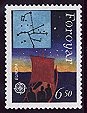 The
Faroes Island stamp shows a Viking ship and the constellations Ursa Major (the Big Dipper)
and Ursa Minor (the Little Dipper). Polaris is the last star in the handle of the Little
Dipper, or in the tail of the small Bear.
The
Faroes Island stamp shows a Viking ship and the constellations Ursa Major (the Big Dipper)
and Ursa Minor (the Little Dipper). Polaris is the last star in the handle of the Little
Dipper, or in the tail of the small Bear.
 In the absence of telescopes, ancient observatories were
necessarily large in order to afford the naked eye observer a chance to detect small
changes in the locations of celestial bodies. The Mayans and even earlier the Babylonians
made astronomical observations, the Egyptians had a calendar based on movements of the
sun. Stonehenge, a series of large concentric stone circles in England, is believed to be
an observatory built between 1000 and 3000 years BC. The monolithic structures that remain
are shown in the British stamp at left, which also contains a vignette of stellar
navigation similar to the Faroe stamp above.
In the absence of telescopes, ancient observatories were
necessarily large in order to afford the naked eye observer a chance to detect small
changes in the locations of celestial bodies. The Mayans and even earlier the Babylonians
made astronomical observations, the Egyptians had a calendar based on movements of the
sun. Stonehenge, a series of large concentric stone circles in England, is believed to be
an observatory built between 1000 and 3000 years BC. The monolithic structures that remain
are shown in the British stamp at left, which also contains a vignette of stellar
navigation similar to the Faroe stamp above.

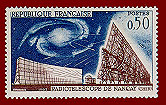

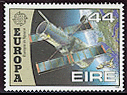
 Giant
telescopes such as at Mt. Palomar and radio telescopes at Joddrell Bank in England and at
Nancay in France now explore space far beyond the universe imagined by Copernicus and
Kepler. But with the deployment of satellite-launched telescopes such as the Hubble Space
Telescope above at right, astronomy has taken an even greater leap forward. No longer
limited by absorption of light by atmospheric
Giant
telescopes such as at Mt. Palomar and radio telescopes at Joddrell Bank in England and at
Nancay in France now explore space far beyond the universe imagined by Copernicus and
Kepler. But with the deployment of satellite-launched telescopes such as the Hubble Space
Telescope above at right, astronomy has taken an even greater leap forward. No longer
limited by absorption of light by atmospheric  molecules, distortions due to dust and the glare of
earthly lights, telescopes can now explore all kinds of radiation emitted from deep in the
galaxy and beyond. We are no longer limited to the visible spectrum impinging on our
retinas as our surrogate detectors record bursts of x rays and
molecules, distortions due to dust and the glare of
earthly lights, telescopes can now explore all kinds of radiation emitted from deep in the
galaxy and beyond. We are no longer limited to the visible spectrum impinging on our
retinas as our surrogate detectors record bursts of x rays and 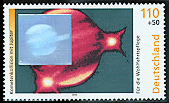 gamma rays from exploding stars.
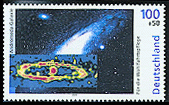
The splendid set of German semi-postal stamps of 1999 depicts the Cosmos and presents the
cutting edge in astronomical observation. Three Max Planck Institutes in Germany produced
the photos on which the stamps are based. The first shows the Andromeda nebula in the
spectrum of 6 cm radiowaves, with a picture of this galaxy in visible light in the
background. Next, there is a section of the Milky Way at 11 cm wavelength in Cygnus,
gamma rays from exploding stars.
The splendid set of German semi-postal stamps of 1999 depicts the Cosmos and presents the
cutting edge in astronomical observation. Three Max Planck Institutes in Germany produced
the photos on which the stamps are based. The first shows the Andromeda nebula in the
spectrum of 6 cm radiowaves, with a picture of this galaxy in visible light in the
background. Next, there is a section of the Milky Way at 11 cm wavelength in Cygnus,  including a
background picture of the constellation from Uranographia, Bode's stellar atlas of 1801,
the last of its kind. Then there are the remains of a supernova in Vela, taken with the
X-Ray Telescope ROSAT orbiting the earth. The dramatic collision of fragments of the comet
Shoemaker-Levy 9 with Jupiter were documented from the Calar Alto Observatory in Spain
with the infrared MAGIC camera. The successive shots were made into a video clip which in
turn was used to produce the hologram. On the right of the picture the planet Io is
disappearing, while the impact explosion is at the bottom of the planetary disk.
Cooperation with NASA on the Compton Gamma-Ray Observatory led to a view of the whole sky
in gamma radiation (last stamp). The CGRO is also pictured, as is a section of the Milky
Way in the background. The addition of holograms on two of these stamps seems like a bit
of overkill or icing on the cake, depending on your point of view...
including a
background picture of the constellation from Uranographia, Bode's stellar atlas of 1801,
the last of its kind. Then there are the remains of a supernova in Vela, taken with the
X-Ray Telescope ROSAT orbiting the earth. The dramatic collision of fragments of the comet
Shoemaker-Levy 9 with Jupiter were documented from the Calar Alto Observatory in Spain
with the infrared MAGIC camera. The successive shots were made into a video clip which in
turn was used to produce the hologram. On the right of the picture the planet Io is
disappearing, while the impact explosion is at the bottom of the planetary disk.
Cooperation with NASA on the Compton Gamma-Ray Observatory led to a view of the whole sky
in gamma radiation (last stamp). The CGRO is also pictured, as is a section of the Milky
Way in the background. The addition of holograms on two of these stamps seems like a bit
of overkill or icing on the cake, depending on your point of view...
 Images of galaxies and nebulae taken with the Hubble telescope appear to the
left on a set issued by the USPS.
Images of galaxies and nebulae taken with the Hubble telescope appear to the
left on a set issued by the USPS.
 These Australian stamps issued in 1992 are part of a minisheet
celebrating the International Space Year. Shown are the Helix Nebula, the Pleiades, and
Spiral Galaxy NGC2997.
These Australian stamps issued in 1992 are part of a minisheet
celebrating the International Space Year. Shown are the Helix Nebula, the Pleiades, and
Spiral Galaxy NGC2997.